AI Chatbot or AI Voice Agent: Which Should Your Business Start With?
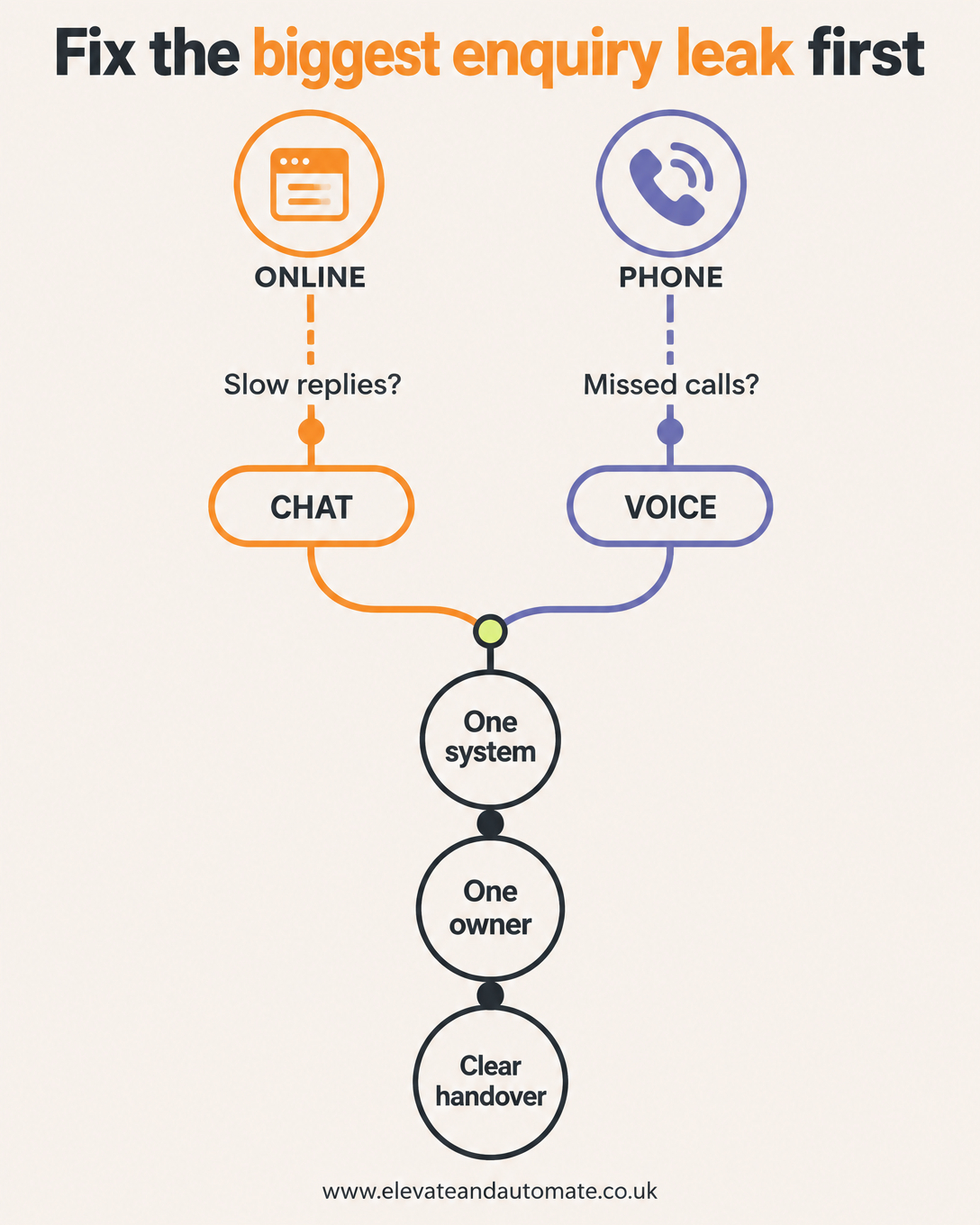
TL;DR: Start with the channel where you lose more enquiries. Pick a chatbot if they come in through your website, and a voice agent if they come in by phone. Before either goes live, sort where enquiries land and who follows them up.
What's the quick answer?
Start with a chatbot if enquiries mostly arrive through your website, social media or contact forms.
Start with a voice agent if the phone is your front door and you regularly miss calls.
Not sure which? Count the online enquiries that went cold and the calls missed or returned late. The bigger number picks the tool.
Before you switch either on, set up one home for enquiries, a named person for follow-up and a clear handover.
Businesses that get value from one tool usually add the other within a year or so.
This question lands in my inbox more than any other right now. A founder has decided AI belongs somewhere in their business, they've watched a few demos, and now they're stuck choosing between a chatbot on the website and a voice agent answering the phone.
Both tools work. I've built and deployed both in live businesses, including my own. Which one goes first depends on your business, and you can sort it in an afternoon if you look at the right things.
Here's how I'd make the call if I were sitting in your chair.
Where are you losing enquiries, and why does it decide the tool?
Before you compare features, look at where enquiries go cold in your business right now. That tells you more than any product demo will.
Nearly every business I look at loses work in one of two places. Either web enquiries sit unanswered while the owner is busy delivering the actual work, or the phone rings out during the day and nobody calls back. Sometimes it's both, though one's usually worse.
Therefore, start with whichever channel is losing you more.
Speed matters, probably more than you'd guess. Customers who get a response within five minutes are 21 times more likely to convert than those who wait longer. So every hour in a client meeting with an enquiry sitting in your inbox costs you real money. You just need to know which channel it's happening on.
Do this today: pull up your last ten enquiries. Note where each one came in, how long it waited for a reply, and what happened next. You'll use that list again further down.
Key point: Your leakiest channel, web or phone, decides which tool goes first. The list of your last ten enquiries shows you which one it is.
When is a chatbot the right first move?
A chatbot suits you when enquiries mostly come through your website, social media or contact forms. Think of it as a receptionist who answers at 2am, picks up while you're on site with a client, and never forgets to ask for a name and number.
Chatbots are also the simpler build. Because they're text based, you can read every conversation, fix the answers, and tighten the handover to you or your team. If you're a founder just starting out with AI, being able to read what it said matters a lot. I'd want that before trusting it with anything.
The numbers point the same way. Around 64% of small businesses plan to adopt AI chatbots by the end of 2026, so some of your competitors are probably already on it.
Start with a chatbot if all three of these sound like you:
Your enquiries arrive mostly through the website or online forms
Your buyers research before they call, and they want quick answers to the same handful of questions
You want to review and adjust what the AI says before you give it more responsibility
Property businesses often fit this. A buyer or tenant browses listings at 9pm, has three questions, and moves on to the next agent if nobody answers. A chatbot can answer them.
Key point: Pick a chatbot when enquiries arrive online and you want to read and adjust every answer before giving it more to do.
When is a voice agent the right first move?
A voice agent suits you when the phone is your front door. Trades, clinics, financial services, anywhere customers pick up the phone because the enquiry feels urgent or personal. A missed call in these businesses usually means the caller rings the next name on the list.
Voice has moved fast. Voice AI now handles 19% of inbound contact centre volume in 2026, up from 6% in 2024. That's larger firms, but the same tools now fit small business budgets.
For high-intent work like appointment booking, voice does well because the caller has already decided to act. They want a time in the diary, and a good voice agent gets them one on the first contact.
Start with a voice agent if these three apply:
Most of your enquiries come in by phone
You regularly miss calls during delivery hours, evenings, or weekends
The main job is simple and repeatable: book an appointment, take details, answer opening questions
If you answer every call yourself right now, this is the bigger win for your time. You stop being the receptionist for your own business.
Key point: Pick a voice agent when the phone is your front door and calls go unanswered during delivery hours, evenings or weekends.
What decides whether either tool actually works?
I'll be blunt here, because this is the bit where these projects either work or fall over.
Whichever tool you pick, it'll capture enquiries. Names, numbers, booked slots, questions that need a human. If those land in a shared inbox nobody owns, you've built a faster way to lose leads.
Before you switch anything on, sort three things:
One home for enquiries. Every lead the AI captures goes into one system, usually a CRM, not a scattered mix of inboxes and notebooks.
A named person for follow-up. Someone who sees every new enquiry and acts on it within a set time.
A clear handover. The AI needs to know when to pass a conversation to a human, and that human needs to know it's coming.
Software salespeople tend to skip this part, which probably explains some of the frustration. Only 14% of small businesses have fully integrated AI into core operations, and nearly half of those using it struggle to choose the right tools. From what I've built, that struggle usually comes from buying the software before mapping the process behind it. Do the mapping first and the tool choice gets a lot easier.
Key point: Either tool only works if captured enquiries have one home, a named owner and a clear handover. Map the process before you buy the software.
Should you end up with both, and in what order?
In practice, businesses that get value from one of these tools add the other within a year or so. The chatbot picks up web traffic, the voice agent picks up calls, and both feed the same system with the same follow-up behind them.
So it comes down to order. Fix the bigger leak first, keep at it until your team uses the tool without thinking about it, then add the second channel once the first runs without you watching. That's what done looks like to me. Nobody drifts back to the old way.
In contrast, doing both at once splits your attention and doubles the adoption work. When I've tried it that way, it's gone worse than one tool done properly.
Key point: You'll probably run both. Fix the bigger leak first, embed that tool, then add the second.
What should you do next?
Do this next. Take the ten-enquiry list from earlier and count two things: enquiries that went cold online, and calls missed or returned late. Whichever number is bigger is where I'd start, because that's where you're losing the most work.
Then, before you buy anything, write down where captured leads will live and who follows them up. If you can't say it in one sentence, fix that first.
Expect the setup to take real effort over a few weeks, including training whoever handles the handovers. That's normal and a small team can manage it. Keep the build simple, since your team has to use it every day.
Key point: Compare cold online enquiries with missed calls and start with the bigger number. Write down where leads will live and who follows up before you buy anything.
Frequently asked questions
Should a small business start with an AI chatbot or an AI voice agent?
Start with the channel where you lose more enquiries. A chatbot suits web, social and form enquiries. A voice agent suits businesses where the phone is the main way customers get in touch.
How do I find out which channel is losing me enquiries?
Pull up your last ten enquiries. Note where each one came in, how long it waited for a reply, and what happened next. Then count enquiries that went cold online against calls missed or returned late.
Why does response speed matter?
Customers who get a response within five minutes are 21 times more likely to convert than those who wait longer. An enquiry sitting unanswered therefore costs you real money.
Why is a chatbot the simpler build?
Chatbots are text based. You can read every conversation, fix the answers and tighten the handover before giving the AI more responsibility.
When does a voice agent make more sense?
It makes more sense when callers contact you by phone because the enquiry feels urgent or personal. Trades, clinics and financial services are typical examples. It also does well on high-intent work like appointment booking.
What needs to be in place before I switch either tool on?
You need one system for captured enquiries, usually a CRM. You also need a named person who follows up within a set time, and a clear handover from the AI to a human.
Will I end up using both?
Probably. Businesses that get value from one tool usually add the other within a year or so. Fix the bigger leak first, embed that tool, then add the second channel.
How long does setup take?
Expect real effort over a few weeks, including training whoever handles the handovers. A small team can manage it if the build stays simple.
Key Takeaways
Your biggest leak, web or phone, decides which tool to start with.
A chatbot fits website, social and form enquiries, and it's the simpler build because you can read every conversation.
A voice agent fits phone-led businesses and high-intent work like appointment booking.
Either tool needs one home for enquiries, a named person for follow-up and a clear handover.
Buying software before mapping the process is where the struggle usually starts.
Add the second tool once the first runs without you watching.
If you want a second opinion on where your enquiries are leaking, that review is exactly the work I do with founders before any software gets chosen.
www.elevateandautomate.co.uk